Case history
Equinor: Martin Linge
Multi-well drilling and gravel-pack completion campaign
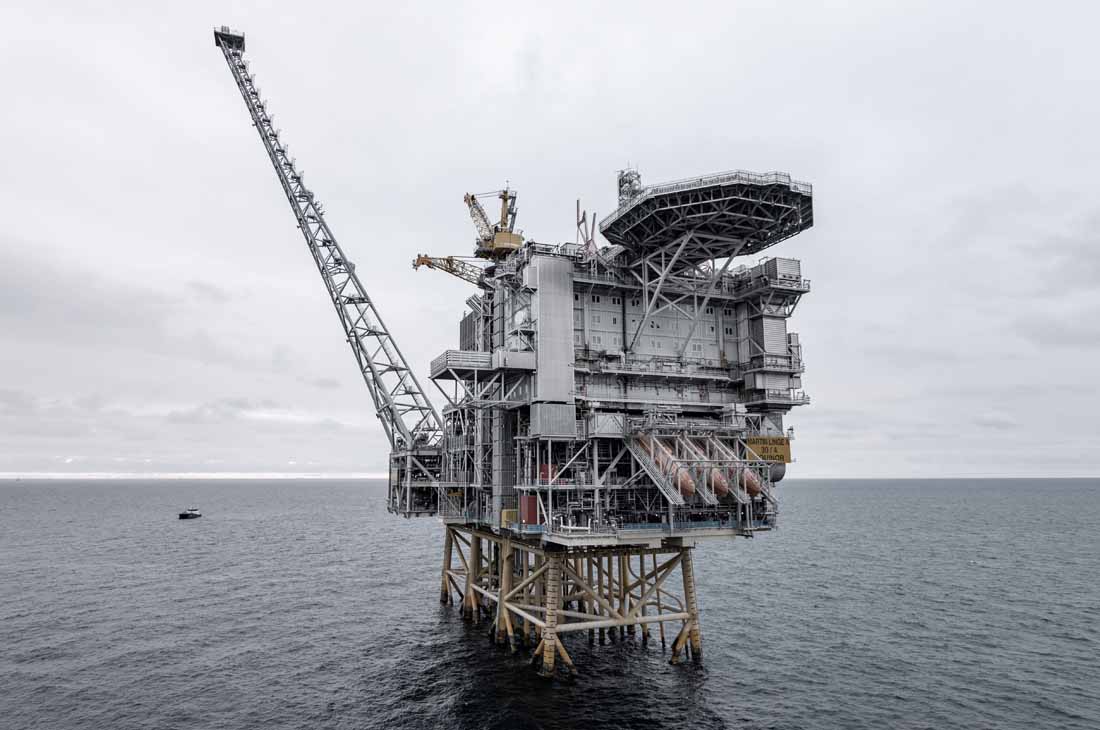
Equinor claims a new world record for the highest-density openhole gravel-pack (OHGP) carrier fluid, accomplished using a cesium/potassium formate-based fluid in four slim-hole high-pressure wells on the Martin Linge field, offshore Norway. This achievement surpasses the previous record of 1.84 g/cm3 (15.4 lb/gal), also held by a cesium formate-based fluid, set in Egypt on the Raven field.
Equinor drilled and completed a series of four wells using gravel packs on the high-pressure Martin Linge field in the Norwegian sector of the North Sea. The preferred slim-hole gravel-pack completion solution posed several technical and environmental challenges for gas production. After careful consideration, cesium/potassium formate brine was identified as the optimal low-viscosity gravel-pack carrier fluid. This brine was selected for its ability to provide the necessary overbalance, adhere to stringent equivalent circulating density (ECD) requirements and meet rigorous HSE standards.
Challenge
Sand control. This was made more problematic by uncertain pore- and fracture-pressure gradients prior to drilling the first well, and a particularly narrow ECD window of +/- 0.10 to 0.12 g/cm3 (+/- 0.8 to 1.0 lb/gal).
Solution
Cesium/potassium formate brine-based fluids, not only used as gravel-pack carrier fluid, but employed in all operational phases from reservoir drilling through to upper-completion installation.
Results
Smooth sand-screen installation with no plugging, 100% gravel-packing efficiency, good flow rates within the extremely narrow ECD window and seamless fluid transitions helped bring the wells on stream early. Expected production was described by Equinor as “world class”, doubling the previous production startup figures for the early Martin Linge wells, which were completed with expandable sand screens and oil-based mud.
(15.3–17.7 lb/gal)
(16.5–17.2 lb/gal)
Breaking new ground
Equinor developed a casing design consisting of a slim-hole reservoir section, completed with 4“ 250 μm sand screens. Effective sand control, crucial for long-term production, made the OHGP-completion strategy the optimal choice.
This strategy required a gravel-pack carrier fluid compatible with both drilling- and screen-running fluids. Equally, the brine could not cause formation or completion damage, and had to meet Norway’s strict HSE requirements. Given its track record with Equinor and previous success on the Martin Linge field under Total, the team at Equinor decided that cesium formate fluid was the right choice, employing it up to a record-breaking OHGP-completion density of 2.06 g/cm3 (17.2 lb/gal).
Clean, Cleaner, Clear
Fluid compatibility was achieved by selecting cesium/potassium formate brine-based fluids, designed and supplied by Sinomine Specialty Fluids, for all operational phases.
Following the successful cased-hole cleanout of solids-laden oil-based mud, formate-based fluids were used to drill and complete the reservoir. Fluid-system continuity throughout the operations ensured the reservoir was only exposed to nondamaging formate filtrates, which removed any associated risks of formation damage by solids-laden fluids. It also provided seamless transitions between the various operational sequences, right through to upper-completion installation, using Sinomine’s ‘Clean, Cleaner, Clear’ philosophy.
For the gravel-pack operations, clear cesium/potassium formate brine is the optimum choice as a carrier fluid for the 20/40-size high-density ceramic proppants. The low-viscosity Newtonian nature of the formate brine facilitates optimum placement of proppants at low flow rates of 500 to 600 lpm.
Sinomine successfully designed and supplied cesium/potassium formate brine-based fluid formulations that could be utilised in all phases from reservoir drilling through to upper-completion installation.
- Clean: A low-solids formate managed-pressure-drilling drill-in fluid, designed to:
- Maximise drilling performance
- Minimise reservoir damage
- Maintain stability of the wellbore to facilitate drawdown tests used to confirm the operational window
- Stabilise the wellbore during lengthy openhole operations
- Cleaner: A low-solids formate tripping- and screen-running fluid, designed to:
- Prevent screen plugging
- Prevent seepage losses while running the lower completion
- Maintain stability of the wellbore to facilitate extended openhole logging runs
- Clear: A formate-brine gravel-pack carrier fluid, designed to:
- Exhibit very low Newtonian viscosity
- Minimise ECDs
- A clear upper-completion formate brine, designed to:
- Provide overbalance during upper-completion installation
The benefits are clear
The Martin Linge wells were successfully brought into production safely within the operator’s scheduled time, after undergoing a seamless transition through all fluid operations from drilling and screen running to gravel packing and upper-completion installation.
Sand screens were successfully installed in the low-solids screen-running fluid without screen plugging. Gravel packing was performed with 100% packing efficiency using cesium/potassium formate brine as high as 2.06 g/cm3 (17.2 lb/gal) at 15.6°C (60°F), which is believed to be a world-record high-density carrier fluid. The low-viscosity brine allowed sufficient flow rates to be achieved within the extremely narrow ECD window to perform a trouble-free OHGP operation.
During field startup, no breaker solutions were required and no sand production or plugging were observed. The productivity of these wells was expected to be double that of those completed with expandable sand screens and oil-based mud during the earlier Total development. The use of formate fluids for drilling and gravel-pack completions ensured that these productivity expectations were met successfully.
In its press release from the opening of the Martin Linge field published on 27 January 2022 entitled “Martin Linge officially opened today“, Equinor states:
“Since production started on 30 June 2021, Martin Linge has delivered world-class production efficiency for a new field in the startup phase.”

This case history and all others are downloadable here.
Literature
Nilsen, S. J., Obrestad, H. U., Kaarigstad, H., Mansurova, N., Solvoll, T. A., Løchen, J., Howard, S., Abrahams, B. and Busengdal, C. (2024, March 13). Reservoir Drilling and Openhole Gravel Packing with High-Density Cesium Formate Fluids in a High-Pressure, Marginal Mud Window Environment at Martin Linge. SPE Journal 1–13. SPE-212487-PA. doi.org/0.2118/212487-PA.
Jøntvedt, E., Fjeldheim, M., Løchen, J., Howard, S., Leon, S., Busengdal, C. and Richard Gyland, K. (2018, February 7). Deployment of Cesium Formate Drill-In and Openhole Completion Fluid in the Martin Linge High Pressure, High Permeability Gas Reservoir Enhances Total’s Operational Efficiency and Radically Improves Well Performance. Proc., SPE International Conference and Exhibition on Formation Damage Control, Lafayette, Louisiana, USA. SPE-189550-MS. doi.org/10.2118/189550-MS.
To provide the best experiences, we use technologies like cookies to store and/or access device information. Consenting to these technologies allows us to process data such as browsing behaviour or unique IDs on this site. Not consenting or withdrawing consent may adversely affect certain features and functions, such as downloading the Formate Technical Manual or MSDSs.